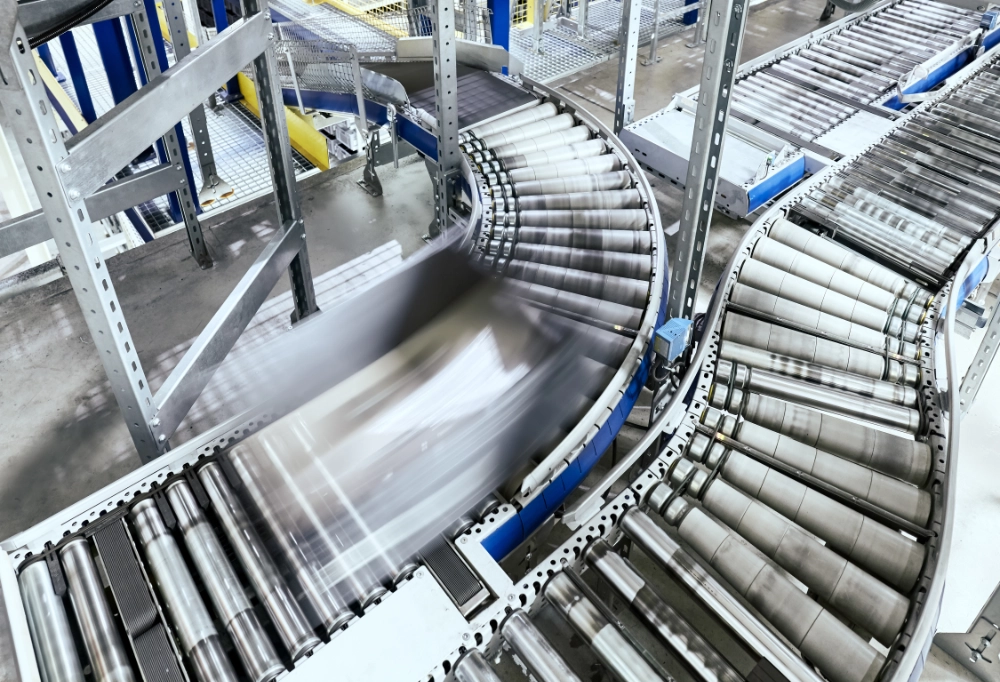
The efficiency of a metalworking plant depends not only on the performance of individual machines, but also on how materials, components, and waste are moved between production phases. A poorly organized flow can lead to delays, manual interventions, and unplanned downtime
For this reason, conveyor belts for the metalworking sector are an integral part of the production process: they connect the various processes and maintain a smooth flow, adapting to the machine’s rhythms and plant needs. Monti Impianti designs customized solutions for applications ranging from shot blasting to filling lines and waste management.
Where do inefficiencies in metalworking processes arise?
The main inefficiencies don’t always stem from production machinery. They’re often caused by discontinuous transfers, uncontrolled accumulations, manual handling, and poorly coordinated connections between different phases of the line.
To identify areas for improvement, it is necessary to observe the process as a whole, from the incoming raw material to the outgoing finished product.
The most frequent situations include:
- components waiting to be transferred to the next job;
- operators repeatedly engaged in manually moving boxes or pieces;
- pallets and containers positioned in unintended areas;
- scraps and chips accumulating near the work centers;
- frequent stops to clear a passage or remove material;
- machines with different speeds that are unable to work in a coordinated manner;
- internal paths that are too long or characterized by poorly functional changes of direction;
- difficulty accessing the conveyors during cleaning, inspection and maintenance.
These problems may seem unrelated, but they often have a common cause: internal handling was not designed together with the production process or was not updated following changes to machinery, volumes, or the plant organization.
Before introducing a new transporter, it is therefore advisable to reconstruct the actual flow, recording the loading and unloading points, waiting times, recurring stops, and the interventions required of the operators.
Why internal handling affects efficiency productive?
Well-organized handling allows materials to be kept available where and when they’re needed. This reduces interruptions between processes and prevents a machine from slowing down because the previous or next phase isn’t properly fed.
The conveyor therefore plays a connecting role between processes that can have different speeds, operating modes and cycle times.
A properly sized system can help to:
- maintain a regular flow;
- reduce manual transfers;
- avoid random accumulations along the line;
- control the positioning of products;
- separate the flows of components, scraps and finished materials;
- connect departments located at different heights or distances;
- coordinate automatic machines and manned stations;
- make the entire production cycle more predictable.
Reducing manual handling doesn’t just mean speeding up transfers: automating repetitive tasks allows operators to focus on tasks that require more attention, such as process control and verifying the correct operation of the line, while avoiding unnecessary movements within the plant.
Conveyor systems can also be connected to production lines, sorting plants, and other automated equipment, creating a continuous, more controllable flow.
Which handling system should you choose for the metalworking industry?
There is no one-size-fits-all technology for every process. The choice must depend on the product’s characteristics, weight, temperature, presence of liquids or debris, the required path, and the loading and unloading methods.
The metalworking industry can handle small and lightweight components, foundry parts, pallets, drums, coils, shavings, dust, and scrap. Each material requires a suitable conveying surface and containment system.
Conveyors for scraps, chips and high-temperature materials
Hinged plate and wire mesh conveyors can be used for horizontal or inclined movements.
In particular, hinged plate conveyors are suitable for the low-speed transfer of metal parts, scrap, and chips, even near work centers. The plates can be equipped with slats to facilitate handling on inclined sections.
Wire mesh conveyors are used when the product must enter or exit ovens or is at a higher than ambient temperature. Here too, the materials, structure, and configuration must be selected based on the actual conditions of use.
Roller conveyors for pallets, boxes and large loads
Roller conveyors are suitable for handling products with a sufficiently rigid and regular base, such as pallets, containers, crates and some types of drums.
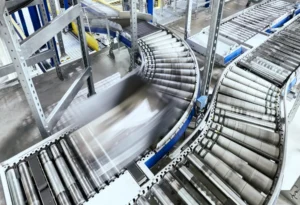
Roller conveyors can be idle, motorized, or configured for accumulation management. Depending on the weight and product, the rollers can be equipped with linings, side containment discs, pinions, axles, and other specific components.
Chain conveyors for medium and heavy products
Chain conveyors can be evaluated for medium-heavy products, pallets or containers that require stable support and controlled advancement.
The configuration can vary based on the number of chains, the distance between the support points, the required capacity and the need to accumulate or transfer the load to other lines.
Belts and augers for different materials
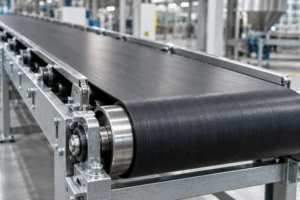
Belt conveyors can be used for components, packages, crates, and materials compatible with a continuous surface. The choice of belt, sides, and any centering systems depends on the product shape and operating conditions.
Screw conveyors , on the other hand, may be suitable for the confined handling of dusty, granular, moist materials, or those whose size is compatible with the spiral. Here too, geometry, speed, and material characteristics must be analyzed before design.
| Material or product | Main need | Technology from evaluate |
| Metal shavings and scraps | Containment and transport to the collection | Hinged plates |
| High temperature parts | Thermal resistance and continuity | Wire mesh |
| Pallets and boxes | Stability and load management | Roller conveyors or chains |
| Mechanical components | Regular transfer between jobs | Tape, rollers or chain |
| Powders and granular materials | Confined transport | Cochlea |
| Drums and containers | Positioning control | Rollers, chains or plates |
The table offers an initial orientation, but does not replace a technical evaluation. Weight, dimensions, center of gravity, temperature, abrasiveness, speed and line configuration can change significantly the choice.
How to design an integrated system with machines existing?
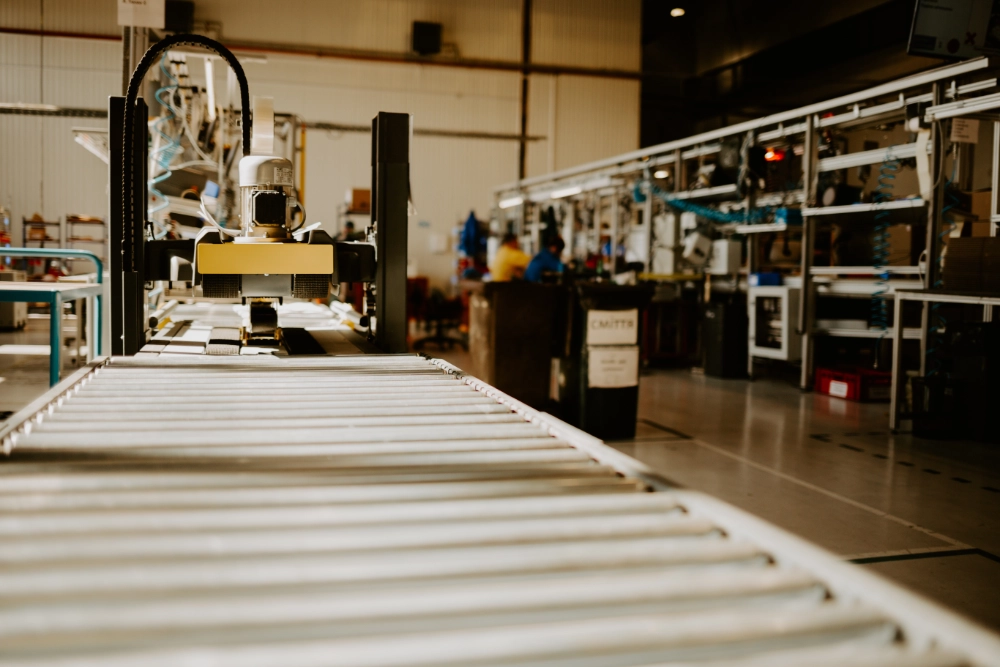
An efficient conveyor must be designed around the actual process and not added to the line as an isolated element. Spaces, dimensions, dimensions, access points, flow rates, and interaction methods with existing machinery must be carefully considered.
Planning should start from the collection of precise information:
- Characteristics of the product being handled;
- Unit weight and hourly capacity;
- Minimum and maximum dimensions;
- Required speed;
- Loading and unloading points;
- Length and layout of the route;
- Presence of curves or changes in level;
- Accumulation requirements;
- Environmental conditions;
- Expected frequency of cleaning and maintenance.
Customized industrial handling systems must provide not only for normal progress but also for the management of transient conditions. Sensors, accumulation logic, speed regulation, and centering devices can help coordinate the various phases.
Monti Impianti handles system design, construction, finishing, and testing in-house, as well as transportation, on-site installation, and after-sales support. An on-site inspection and analysis of the production environment allow us to define the configuration based on the space and technical specifications of the system.
How to reduce jams and unplanned downtime?
Preventing downtime starts with proper product handling during transfer.
Lateral containment, centering, regularity of power supply and accessibility of components affect the continuity of the line.
In the metalworking industry, the presence of dust, shavings, swarf, oil, and residues can increase the risk of buildup and jamming. The system must therefore be configured so that the material does not reach sensitive areas or interfere with mechanical parts.
Monti Impianti systems for the metalworking industry are developed with particular attention to product and debris containment, thus limiting jams, machine downtime, and the need for extraordinary cleaning.
Maintenance must be considered right from the design stage. Even a reliable component can cause problems if it’s difficult to access during inspections or replacements. Therefore, casings, guards, and sides must ensure safety without hindering periodic checks .
Spare parts availability and timely after-sales service also contribute to operational continuity. Monti Impianti supports installed lines and supplies the necessary components for its handling systems.
What indicators help evaluate improvement?
Efficiency must be measured by comparing the conditions before and after the intervention. It’s not enough to verify that the conveyor is working: you need to understand whether it has actually reduced waiting times, stops, and manual work.
Indicators may vary depending on the process, but it is useful to monitor:
- time required to transfer the product between two processes;
- number and duration of micro-stops;
- frequency of manual interventions;
- quantity of material accumulated off-line;
- stoppages caused by jams;
- time spent removing chips and waste;
- frequency of maintenance interventions;
- line availability;
- products damaged during transfer;
- actual capacity compared to expected flow rate.
Data collection must focus on points where the process loses continuity. An increase in conveyor speed, for example, doesn’t automatically lead to an improvement if the next machine can’t receive the product at the same rate.
The goal is therefore not to achieve the maximum possible speed, but to build abalanced flow, capable of respecting the timing of the various processes without generating bottlenecks or excessive backlogs.
Frequently asked questions about metalworking process efficiency
Can internal handling really reduce production times?
Yes, when material transfer causes delays or requires frequent manual intervention. The actual benefit, however, depends on the correct sizing of the system and its coordination with the connected machines.
Which conveyor is best for handling metal shavings?
Hinged plate conveyors are often used to transfer metal chips and swarf, even on inclined paths. The final choice depends on the quantity, shape, temperature, and presence of liquids or residues.
Is it possible to integrate a new conveyor into an existing line?
Yes, but it’s necessary to verify dimensions, dimensions, speed, loading and unloading methods, electrical system, and operating logic of existing machines. A technical inspection allows us to determine these conditions before designing.
How do you manage machines with different production speeds?
Accumulation areas, sensors, speed regulation, and coordinated start and stop logic can be provided. The accumulation area must be sized based on the duration and frequency of expected slowdowns.
Does a faster conveyor always make the line more efficient?
No. Excessive speed can transfer the bottleneck to the next stage or cause buildup, instability, and difficulty controlling. Speed must be consistent throughout the entire production cycle.
When is it best to choose a custom system?
Custom design is particularly useful when there are limited spaces, complex routes, irregular products, heavy loads, specific environmental conditions, or machines with different operating modes.