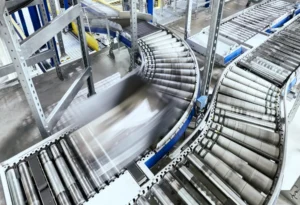
Correctly adjusting a conveyor belt is an operation that ensures the efficiency of industrial handling systems and prevents premature wear of components. To adjust a conveyor belt effectively, two interdependent parameters must be addressed:
- tensioning, necessary to avoid slipping on the drive drum
- alignment, essential to keep the carpet aligned.
The standard procedure involves a gradual and symmetrical tensioning, followed by a dynamic centering based on the adjustment of the return rollers.
This technical guide, written by the experts at Monti Impianti , was created with the aim of providing a definitive operating protocol for conveyor belt adjustment, overcoming the “do-it-yourself” approximations that often cause machine downtime and structural damage.
Preliminary parameters for adjusting the conveyor belt
At Monti Impianti, before proceeding with mechanical calibration, we apply a structural verification protocol: adjusting the tensioners without first verifying the stability of the frame and the geometry of the conveyor belt is a mistake that leads to unstable adjustments. There are two “mechanical constraints” that, if ignored, make it impossible to achieve reliable adjustment of the conveyor belt:
- Orthogonality of the joint (geometric constraint): If the belt has been cut or spliced out of square, it will exhibit constant cyclic drift. In this case, the problem is intrinsic to the shape of the belt: any attempt to adjust the conveyor belt by acting on the rollers will be ineffective because the structure of the belt itself will always push off-axis.
- Component cleanliness (dimensional constraint): Even minimal residue accumulated on the rollers alters their pitch diameter. This asymmetric variation creates a difference in tension and speed between the two sides, rendering any conveyor belt tensioning or fine centering operations futile.
Conveyor belt tensioning: operating protocol
Conveyor belt tensioning does not only have the function of transmitting motion; it’s also crucial for stabilizing the conveyor during loading. Monti Impianti ‘s experience highlights a recurring critical error: applying excessive force, which compromises the integrity of bearings and joints.
To avoid this risk and adjust the conveyor belt according to professional standards, we follow three fundamental rules:
- The rule of symmetry (gradual tensioning): The tensioners must be operated in small increments, constantly alternating between the right and left sides. Only this procedure ensures that the rollers remain parallel, preventing the belt from being born misaligned.
- The maximum load criterion (slippage test): The tension is considered optimal only at the exact point where the belt stops slipping on the drive drum during peak load. Every millimeter of traction beyond this point is useless and harmful.
- Slack-side compensation (drift management): If the belt deflects because it’s overly tensioned on one side, good engineering practice suggests loosening the opposite side rather than increasing tension where the belt “runs away.” This approach prevents exceeding the nominal parameters, which remains the primary cause of splice failure.

Conveyor belt alignment and dynamic tracking
Conveyor belt alignment (or tracking) aims to center the belt firmly on the structure. This operation is based on a precise physical principle: the belt always moves toward the side where it first encounters an obstacle or where the tension is less. To manage this dynamic and prevent lateral drift, Monti Impianti’s experience suggests working on three levels of control:
- Directional correction (roller adjustment): If the belt deviates to the left, you need to increase the tension on the left side or advance the roller support on that side. This adjustment forces the belt to mechanically converge toward the center, restoring balance.
- Kinematic analysis (derived from orientation): In specific cases, such as with very short or wide belts, the conveyor belt alignment may not be related to tension, but rather to the orientation of the rollers. If increasing the tension on the left causes the belt to continue to move to the left, this means the kinematics are governed by the angle of the rollers. In this situation, the logic must be reversed and the roller inclination adjusted relative to the trajectory.
- Perpendicularity constraint (parallelism): To ensure long-lasting conveyor belt alignment, it is essential that each roller be perfectly perpendicular to the lubber line of the structure. Without this basic parallelism, any adjustment of the tensioners will be precarious and subject to constant drift.

Factors affecting conveyor belt adjustment
In addition to mechanical adjustments, there are physical and operational variables that determine tracking stability and are often overlooked in standard manuals. For truly effective conveyor belt adjustment, three critical factors must be analyzed:
- Relationship between thickness and flexibility: The structure of the belt directly affects the response to controls. A thin belt is significantly easier to manage because it adapts more precisely to the camber of the rollers; conversely, a thick, rigid belt offers mechanical resistance that makes centering more difficult.
- Eccentric load dynamics: A belt is often aligned when idle but deviates dramatically during operation. If material falls sideways onto the belt, inertia forces move the belt off-axis. For this reason, the conveyor belt alignment must always be validated through a double test, both at rest and at full load. In these cases, in addition to adjustment, the use of concave belt conveyors to self-center the material is considered, or lateral guide pads are added to the frame to compensate for belt deviation due to product lateral loading.
- Lagging: The grip between the belt and the drum is crucial. Uneven wear of the rubber coating on the drums compromises adhesion, making the conveyor belt tension unstable and causing drifts that cannot be corrected by adjusting the tensioners alone.
FAQ: Frequently Asked Questions about Conveyor Belt Adjustment
How can I adjust conveyor belt if it only wobbles in one spot?
If the drift always occurs at the same point on the frame, the problem is an out-of-square or dirty support roller. If it always occurs at the same point on the belt, the problem is the joint.
What does incorrect conveyor belt tensioning mean?
Insufficient tension causes slippage, heat, and belt wear; excessive tension leads to breakage of the supports and bearings, and the weakening of the carpet fibers.
Why does the belt alignment change when loaded?
The load exerts lateral forces. If the load is not perfectly centered, it will shift the belt. In these cases, it is necessary to install centering guides or self-aligning rollers.
The expertise of Monti Impianti
Performing proper conveyor belt adjustments requires pinpoint precision and a thorough understanding of mechanical dynamics. Improperly adjusting a conveyor belt means accepting higher maintenance costs and the risk of production downtime.
Do you need technical support for conveyor belt tensioning or to solve complex alignment problems?
Contact Monti Impianti technicians for a consultation or professional calibration of your handling systems.