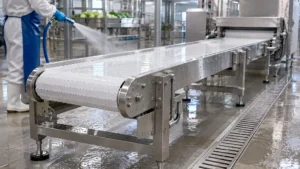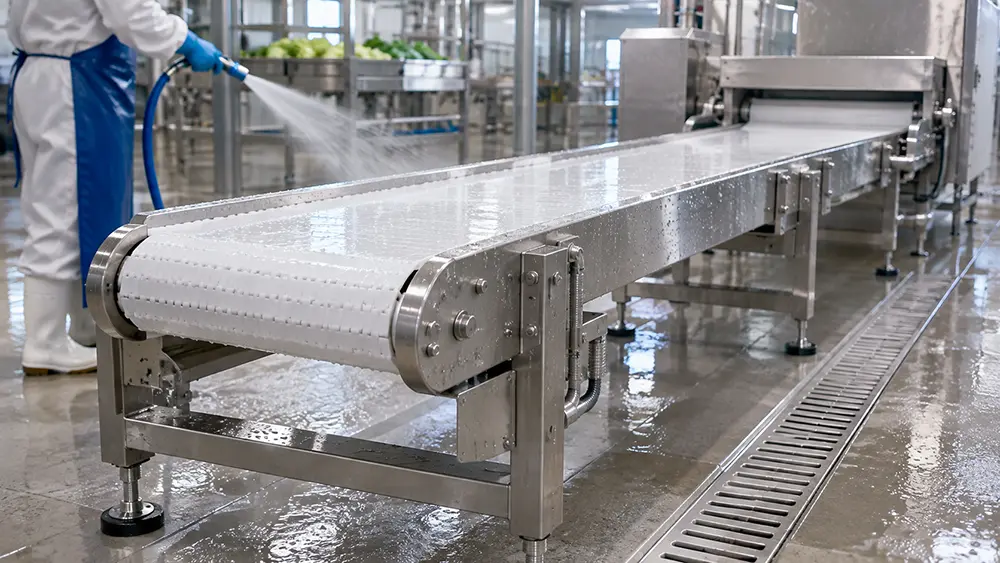
In production environments subject to frequent cleaning and sanitization, designing a conveyor system means considering from the outset how water, detergents, and residues will interact with the system.
Washdown conveyors , in fact, are not simply conveyors that can be wetted or built in stainless steel: geometries, materials, drainage, accessibility and components must be evaluated as a whole.
This topic is particularly relevant in the food industry, where hygiene requirements can affect both packaged and unpackaged foods. In designing our conveyors for the food sector , the characteristics of the line are therefore defined according to the product , the production process and the actual cleaning and sanitation needs .
Consequently, there is no washdown configuration that is suitable for every application. A line subjected to occasional rinses presents very different conditions than a system frequently washed with water and specific cleaning products.
What does it mean to design a conveyor for washdown environments ?
washdown conveyor means considering washing operations as a true operating condition of the system . It’s not enough to ensure that the materials are water-resistant: it’s also necessary to understand where liquids and residues will end up, which parts must be reached during cleaning, and how the most sensitive components will be protected.
In the food industry, this principle is also reflected in Regulation (EC) No. 852/2004 on the hygiene of foodstuffs.
For equipment that comes into contact with food, the Regulation requires, among other things, that it be capable of being effectively cleaned and, when necessary, disinfected. It must also be constructed and installed to reduce the risk of contamination and allow for adequate cleaning of the equipment and the surrounding area.
Hygienic design principles developed by EHEDG ( European Hygienic Engineering & Design Group).
In particular:
- EHEDG GL 8: defines general principles of hygienic design based on the prevention of contamination risks.
- EHEDG GL 13: Details the design criteria for equipment used in open food processing environments subjected to wet cleaning.
- EHEDG GL 43: specifically addresses the hygienic design of belt conveyors for the food industry.
It’s important, however, not to confuse the terms washdown and hygienic design . The former generally indicates the need to subject a system to washing, while the latter concerns a broader design approach aimed at promoting adequate hygienic conditions for the intended use.
What characteristics should a transporter subjected to frequent washing have?
A system intended for frequent washing must allow water and residue to be removed without creating hard-to-reach spots or areas where they can stagnate. Therefore, cleanabilitydepends as much on the shape of the structure as on the materials used.
The main aspects to be evaluated during the design phase include:
- frequency and washing method
light rinses and intensive washes may require different solutions - drainage of liquids
the structure must facilitate, when necessary, the flow of water used during cleaning - accessibility
the parts to be cleaned and inspected must be able to be reached without excessive difficulty - To reduce accumulations,
it is necessary to limit, as far as possible, the areas in which product residues, dirt or water can deposit - components
, sensors and other elements must be chosen considering the environmental conditions and exposure to washing - maintenance
the configuration must allow control and maintenance interventions compatible with the production organization
When designing our handling systems, we can include, depending on the application, slots to facilitate cleaning of internal parts, easily removable covers, collection trays and structures designed for washing.
These measures are not adopted indiscriminately on every system, but are evaluated based on the characteristics of the product and the specific needs of the process.
Drainage and accessibility must be designed together
One of the most important aspects concerns the behavior of liquids after washing .
Making a surface accessible is of little use if the system’s geometry subsequently favors water stagnation in other areas. Therefore, drainage and accessibility must be considered together.
A structure that facilitates access to internal components can simplify cleaning and subsequent inspections. Conversely, areas that are difficult to reach or where debris accumulates may require more complex interventions. Considering these aspects during the design phase therefore facilitates not only cleaning, but also subsequent inspection and maintenance activities.
The indications contained in the EHEDG guidelines, in particular in GL 43 dedicated to food belt conveyors, confirm the importance of evaluating design solutions in relation to the product, the actual conditions of use and the hygiene risk.
washdown conveyors ?
The choice of materials for a washdown conveyor must take into account the product being handled, the production environment, and the planned cleaning procedures. Stainless steel is an important option, but it alone does not determine the system’s suitability for frequent cleaning.
During the design process, several elements must be evaluated.
- Stainless steel structure: we can provide AISI 304 or AISI 316 carpentry, choosing the material based on the operating conditions and the agents used.
- Mat material: PVC, polyurethane, and rubber have different characteristics. The choice depends on handling needs and compatibility with cleaning procedures.
- Components in contact with the product: in food applications, they require particular attention, also with respect to applicable regulatory requirements.
- Structure geometry: must facilitate access to the surfaces to be cleaned and limit, as far as possible, points where water and residues can accumulate.
For our belt conveyors , materials and construction features are defined based on production needs. For food applications, we can also provide stainless steel construction for the parts of the structure that come into contact with the product.
AISI 316 should not be automatically considered necessary in every washdown environment . The choice over AISI 304 requires an evaluation of the characteristics of the environment , the chemicals used , the washdown conditions and the project specifications .
When a plastic component is intended for direct contact with food, it is also necessary to check the applicable regulatory requirements, including, where relevant, those set out in the Regulation (EU) No. 10/2011 . The configuration must therefore be defined by considering the behavior of the entire system both during production and during subsequent cleaning operations.
Modular belt or chain: what changes in a washdown environment ?
The choice between a continuous belt and a modular chain depends on the product and the production process. However, in environments subject to frequent cleaning, the cleaning and drainage of the conveyor surface is also particularly important.
There is no one technology that is always preferable: both can be evaluated for applications that require specific cleaning and sanitization conditions.
Modular chain conveyors
The modular chain conveyors can be configured, depending on the application, with open or closed links.
When it’s necessary to facilitate the downward flow of water or washing liquids, using open meshes can be advantageous. The frames can also be equipped with slots to facilitate the sanitization of internal parts.
In food applications, this type of conveyor can be used to handle naked, packaged or frozen products , with configurations defined according to production needs.
Continuous belt conveyors
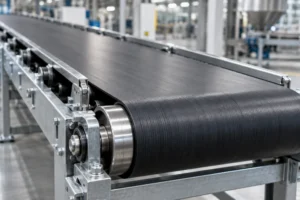
Continuous belt conveyors can be a suitable solution for numerous industrial applications, including food, depending on the product and process.
In the presence of frequent washing it is necessary to carefully evaluate:
- material and surface characteristics of the carpet;
- accessibility of the sliding surface and the areas below;
- configuration of rollers, supports and tensioning systems;
- possibility of removing residues and liquids during cleaning operations.
The choice must therefore not be based exclusively on the type of conveyor, but on the configuration’s ability to simultaneously satisfy handling and cleaning needs.
The correct question is not simply “which is better, a conveyor belt or a modular chain?” , but which system allows the product to be handled correctly and manage the required washing protocol.
How do you properly design a handling system for frequent washing?
The starting point must be the actual process , not the a priori choice of a material or a conveyor model.
Before defining the solution, it is necessary to know the product being handled , the hygiene requirements , the cleaning methods and the environmental conditions in which the system will have to work.
The design logic can be summarized through a precise sequence:
- moved product
- hygiene requirements
- washing protocol
- materials and configuration
- drainage and accessibility
- components
- maintenance
Each phase guides subsequent choices: the following table summarizes the main information to be collected and the possible design consequences.
Aspects to check before designing
| Aspect to evaluate | Why it’s important | Possible design choice |
| Product moved | Determine hygiene and transportation needs | Specific materials and configuration |
| Frequency of washing | Affects the plant’s exposure to water | Suitable structure and components |
| Cleaning method | Rinsing and intensive washing have different needs | Protection of sensitive parts |
| Detergents used | They can affect the compatibility of materials | Evaluation of the materials used |
| Drainage | Helps limit fluid retention | Geometries and collection systems |
| Accessibility | Makes cleaning and inspection easy | Removable covers and dedicated openings |
| Maintenance | It affects the practicality of interventions | Adequate spaces and access |
One aspect that deserves particular attention concerns the electrical components .
The norm IEC 60529 defines the IP code classification system for electrical enclosures.
In a washdown environment , the degree of protection for individual components must be chosen considering the modes of exposure to water, including the intensity , direction , and frequency of washing.
There is therefore no universal IP rating for all transporters intended for this type of environment.
What mistakes can make washing and maintenance more difficult?
Many critical issues arise when cleaning needs are considered only in the final stages of design.
A system may handle product properly but be impractical to wash, inspect, or maintain over time.
Among the most important design errors we find:
- Consider stainless steel sufficient.
A structure made of this material does not automatically guarantee accessibility, drainage, or compatibility with any cleaning procedure. Geometry, components, and surfaces must also be evaluated. - Not knowing the cleaning protocol
Frequency, water pressure, temperature, and detergents used can significantly change system requirements. - Neglecting hard-to-reach areas
Accumulation points, poorly accessible covers, and insufficient space can complicate the removal of water and residues. - Separate cleaning and maintenance
A poorly accessible configuration can make both sanitization operations and technical interventions more difficult.
To avoid these critical issues, it is important to consider the actual conditions in which the system will have to operate from the outset.
When designing our handling systems, we start with the product characteristics and process data provided by the customer. When necessary, we conduct surveys to better understand the available space, interference, and production environment conditions.
This approach allows for an integrated assessment of production, cleaning and maintenance needs , identifying the most appropriate construction solutions for the specific application.
Washdown Conveyors
What does washdown mean in an industrial plant?
The term generally refers to the presence of procedures for cleaning the system with water and, depending on the process, detergents or other products. Intensity and frequency can vary greatly: for this reason, the design must begin with the actual planned cleaning protocol.
Are all stainless steel conveyors suitable for washdown ?
No. Stainless steel is just one factor to consider. Structure geometry, drainage, accessibility, conveying surfaces, components, and washdown methods must also be considered.
What’s the difference between a washable conveyor and one designed according to hygienic design criteria?
A washable conveyor may be compatible with certain cleaning operations. Hygienic design, on the other hand, is a broader design approach that considers accessibility and contamination risk prevention in relation to the intended use. The two concepts may overlap in some applications, but they are not equivalent.
Which tape is best suited for frequent washing?
There is no universally best-suited tape for frequent washing. The choice between different types must consider the product being handled, potential food contact, compatibility with detergents and temperatures, as well as ease of access to surfaces and the ability to remove water and residue.
How do you prevent water from stagnating in a conveyor?
Drainage must be considered in the system’s geometry. Depending on the configuration, openings, slots, collection systems, and structures that facilitate liquid drainage may be included. When applicable, the use of modular chains with open links can also contribute to drainage.
What IP rating is needed in a washdown environment ? There is no single IP rating that is suitable for all
washdown environments . The protection must be chosen based on how the component will be exposed to water, considering factors such as the intensity, direction, and frequency of exposure, and the characteristics of the specific equipment.
Designing washdown based on real-world conditions
A handling system intended for frequent washing must be designed by relating production , cleaning and maintenance needs .
Carpentry materials, transport surfaces, drainage, accessibility, and components are not independent elements, but parts of the same project.
For this reason, before selecting the conveyor configuration, it’s important to understand in detail what needs to be handled, how the line will be cleaned, and the conditions it will operate under. Based on this data, we can develop customized handling systems that also consider cleaning requirements from the early design stages.