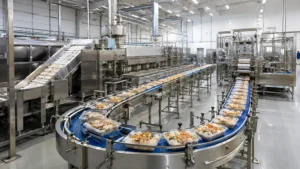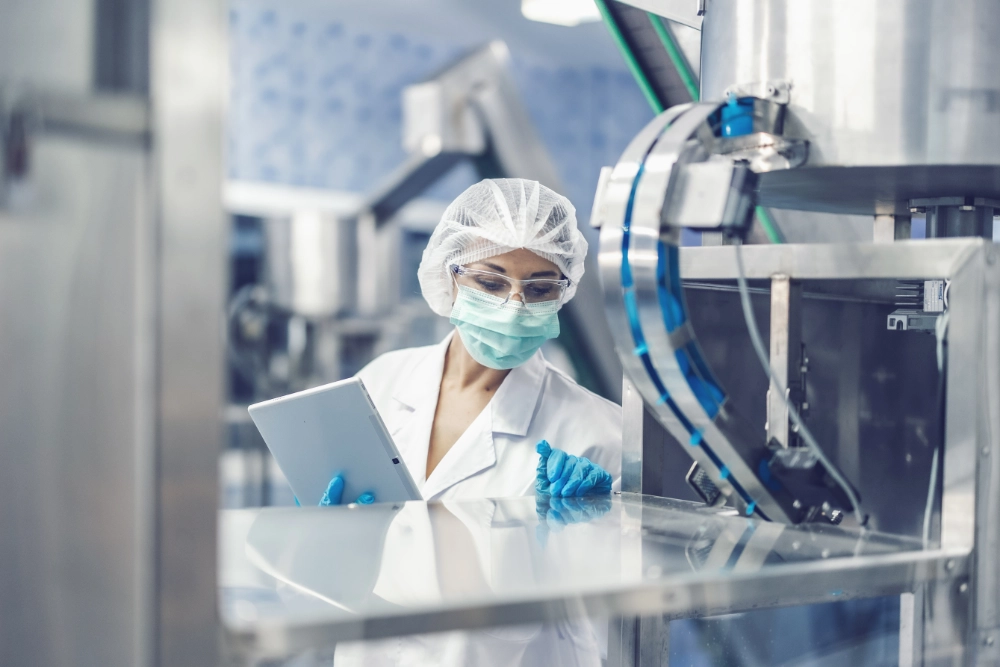
Handling in the pharmaceutical industry allows products and packages to be moved in an orderly fashion along the production line. A well-designed system helps keep the process flowing smoothly, reducing the risk of jams, damage, and downtime that can slow down production.
For this reason, automating handling means not only moving products faster, but creating a controlled and coordinated flow, designed based on available space, machine speed, and the characteristics of the materials being transported.
Conveyors for the pharmaceutical industry must therefore be configured considering aspects such as stability, product integrity, ease of cleaning, accessibility for maintenance and the possibility of integration with existing equipment.
Why pharmaceutical handling requires criteria specific?
Handling in the pharmaceutical industry must maintain a smooth flow without compromising the integrity of the product or packaging. Each system must be evaluated in relation to the process in which it will be installed, not as an isolated element.
Medicine boxes, vials, bottles, and syringes require different transport methods. The system must therefore be designed taking into account the product’s size, weight, and stability, especially when there are curves, changes in level, or transitions between multiple conveyors.
Even a small discontinuity can cause problems:
- product overturning;
- uncontrolled accumulations;
- jams at passage points;
- collisions between packages;
- slowdowns upstream of the line;
- frequent stops for manual repositioning;
- difficulties during format changes.
To avoid these situations, it is necessary to carefully study speed, useful width, lateral guides, sides, curvature radii and transfer points.
The design must also consider the procedures adopted in the plant for cleaning, maintenance, quality control, and management of different production batches. A seemingly minor component, such as a difficult-to-access guide or an area where residue accumulates, can complicate operations.
The advantages offered by automated handling
The main advantage is not only speed, but the ability to coordinate the transport, accumulation and progress of the product.
Compared to a predominantly manual management, an automated system can contribute to:
- reduce manual movements between machines;
- maintain constant power supply to the equipment;
- limit waiting times and downtime;
- manage accumulations without immediately stopping the line;
- reduce the risk of packages falling or damaging;
- improve process repeatability;
- automatically separate compliant products from waste;
- coordinate machines with different operating speeds;
- facilitate control of production flow.
Automation is especially useful when one stage works faster than the next.
In these cases, the handling system can create a controlled accumulation, preventing a brief interruption from immediately spreading to the entire system.
Photocells, sensors, pneumatic switches, stopping systems, and control devices can also allow the line to react to the presence, absence, or position of the product.
The configuration must however be defined on the real process.
Which conveyors are used in pharmaceutical lines?
There’s no single type of conveyor that’s right for all pharmaceutical applications. The choice depends on the product, route, elevation changes, required speed, available space, and operations to be performed along the line.
Belt conveyors for delicate and small-sized products
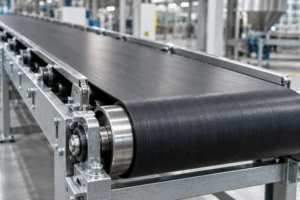
Belt conveyors allow for the handling of products with different sizes and support surfaces. They can be used for boxes, packages, bottles, or components that require a continuous conveyor system.
The mat is chosen based on the friction coefficient, the presence of slopes, and the required level of stability. The system can be completed with:
- adjustable side guides;
- containment sides;
- longitudinal or transverse profiles;
- slats;
- small diameter transfer beams;
- passages designed to reduce the spaces between two conveyors.
These elements are especially important when you have to transfer light products or products with a small base.
Chain conveyors for accumulation and flow control
Chain conveyors are suitable for handling packaged products and can be integrated with control, sorting, and reject systems. Table-top chains, combined with adjustable guides and pneumatic diverters, allow for handling different formats and directing products towards specific paths.
Belt elevators for height changes
Belt elevators allow lightweight loose products to be transferred between different levels without the need for manual handling. The conveyor can be equipped with slats that help keep the material stable during the inclined section.
In the pharmaceutical sector, Monti Impianti also presents a PVC belt elevator designed for handling syringes, complete with a loading hopper, guards, and opening panels. Many for accumulation and orientation.
Rotating tables to organize the end of the line
The rotating tables can be inserted during loading or at the end of the line to temporarily collect products and change their direction of travel. The configuration of the table and guides is determined based on the shape, weight, and stability of the packages.
How to make cleaning, maintenance and format changes easier
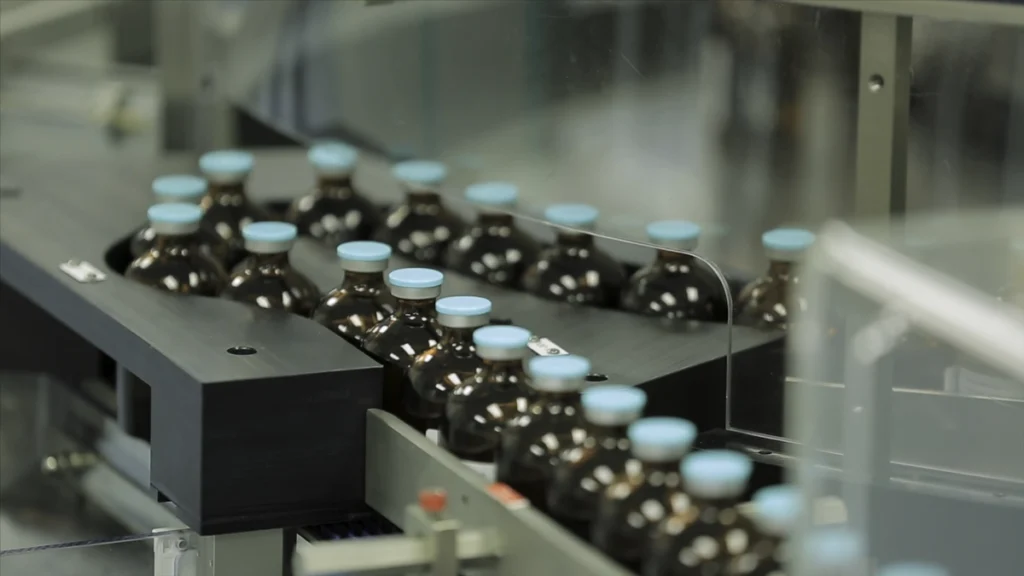
A conveyor intended for a pharmaceutical environment must be designed with the activities that occur while the line is idle in mind. Accessibility, materials, and structure geometry directly influence cleaning, inspection, and maintenance.
The machine parts can be made of stainless steel, a material used for its resistance to corrosion and the possibility of adopting surfaces suitable for the cleaning procedures required by the plant.
Monti Impianti offers the option of manufacturing conveyors in AISI 304 or AISI 316 stainless steel, choosing the material best suited to the specific characteristics of your production environment. Satin finishes are also available for pharmaceutical and food applications, designed to achieve uniform surfaces that are easier to clean.
Ease of cleaning also depends on the conveyor’s overall structure. During the design phase, it is therefore important to consider:
- the presence of hard-to-reach areas;
- the accessibility of the parts underneath the tape;
- the ability to easily remove casings, sides and shelves;
- the protection of motors and electrical components;
- the shape of the supports;
- the possible presence of cracks or cavities;
- the correct management of liquids used during washing.
Format changes , on the other hand, require guides and adjustments that can be adapted without complex interventions. When the same line handles different packages, it is useful to provide references, adjustment systems, and components that facilitate repositioning.
Safety and compliance of the production process
Conveyor safety and pharmaceutical process compliance are related but distinct aspects. The machine must comply with applicable technical and safety requirements, while the pharmaceutical company must ensure its proper integration into its production and quality system.
European Good Manufacturing Practices, collected in EudraLex (European Commission – EudraLex Volume 4), include information on equipment, risk management, qualification, and validation. Therefore, the presence of the required documentation for the carrier does not automatically ensure compliance with the entire process.
The user must verify that the system is compatible with:
- operating procedures and cleaning methods;
- characteristics of the products handled;
- process controls and risk assessment;
- qualification and validation activities;
- maintenance and traceability of interventions.
Machinery safety regulations must also be assessed based on the date of placing on the market or putting into service. Directive 2006/42/EC remains applicable until January 19, 2027, while European Regulation 2023/1230 will come into force on January 20, 2027.
For systems destined for the European Union, Monti Impianti issues the CE declaration of conformity. Any additional requirements, such as electrical specifications for foreign markets or measures for specific environments, must be defined during the technical analysis. ATEX compliance must also be assessed separately when required by the operating conditions.
Customized system design
An effective handling system must be designed based on the actual characteristics of the product, the line, and the plant. An incorrectly sized standard solution can cause slowdowns, transfer issues, or difficulties integrating with other machinery.
| Element to be evaluated | Why it’s important |
| Product dimensions, weight and stability | They determine the type of belt, guides and transport speed |
| Route, curves and differences in altitude | They influence the size, transfers and configuration of the line |
| Required speed | It must be coordinated with the upstream and downstream machines |
| Formats to manage | They require adjustable guides and components |
| Available spaces | They influence the length, direction and structure of the system |
| Cleaning and maintenance | They determine materials, accessibility and construction |
| Sensors and security systems | They allow you to control the flow and protect operators |
Monti Impianti develops customized handling systems starting from an analysis of production needs and, when necessary, a site visit. The service includes design, construction, testing, installation (if required), and after-sales support.
This approach allows for the coordination of conveyors, sensors, speed, space, and maintenance activities right from the design stage, evaluating the operation of the entire line and not just the individual machine.
FAQs on pharmaceutical handling
Which pharmaceutical products can be handled automatically?
Boxes, vials, bottles, syringes, and other packaged products can be handled. Feasibility depends on the product’s size, weight, stability, support surface, and sensitivity.
Which conveyors are used in the pharmaceutical industry?
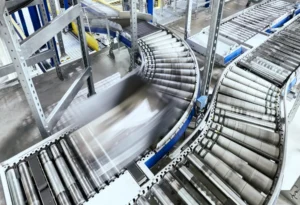
Solutions may include belt conveyors, chain conveyors, table-top chains, roller conveyors, elevators, and rotary tables. A line often integrates multiple technologies to manage different sections and functions.
Is stainless steel always necessary?
Not necessarily for every part of the system. The choice depends on the intended use, the environment, cleaning procedures, and the risk of contact with the product. Specifications must be defined with the customer.
How do you reduce jams?
Guides, sides, conveyor transitions, speed, and accumulation zones must be properly designed. Product stability and the management of format changes also affect the risk of jamming.
Can a conveyor be integrated into an existing line?
Yes, but it’s necessary to record the dimensions, dimensions, speeds, switching signals, and characteristics of the machines already installed. A technical inspection allows us to identify any constraints before designing.
Are CE marking and GMP compliance the same thing?
No. Machine compliance concerns the requirements applicable to its construction and marketing. GMP compliance, on the other hand, concerns the pharmaceutical process as a whole and must be assessed by the user through procedures, qualification, validation, and risk management.