Industrial waste management represents an increasingly pressing challenge for companies, both in terms of environmental sustainability and operational efficiency . Automating this process not only reduces costs and optimizes productivity, but also improves workplace safety and ensures compliance with current regulations.
In this article, we explore the advantages of automation, the process stages that can benefit from it, the most effective technologies—with a focus on conveyor belts —and Monti Impianti’s role in designing tailored solutions for a more efficient and sustainable future.
Why is it worth automating industrial waste management?
Automating the transportation of industrial waste allows for increased production efficiency , reduced operating costs , and improved safety.
Companies that process industrial waste must manage heterogeneous flows, critical materials, and increasingly stringent environmental regulations. Automating handling brings significant benefits, as it allows for:
- Reduce process times and labor costs : an automated system works 24/7 without interruption, avoiding the downtime associated with manual management and allowing human resources to be allocated to higher value-added tasks.
- Avoid bottlenecks and machine downtime : the continuous and controlled flow of materials reduces overloads and allows for more stable management of the shredding, selection and pressing phases.
- Improve staff safety : Less manual handling means lower risk of injury, exposure to hazardous materials or fine dust.
- Control and track flows in real time : automation allows you to integrate sensors, dynamic weighing, and artificial vision systems to monitor and document every stage of the process.
According to research published on ResearchGate ( ResearchGate – Efficiency of Material Handling Systems (2024) ), handling automation has led on average to an increase in efficiency of 28% and a reduction in operating costs of 22% (and this also happens in the waste treatment sector.

Which waste treatment phases benefit from automation?
The phases that benefit most from automation are feeding, transfer between machines and storage.
Not all industrial waste management activities require the same level of automation, but there are some critical phases where automated systems make a difference:
- Initial Feed : Hoppers and conveyor systems such as inclined belts, belt elevators or screw conveyors ensure continuous, controlled loading from bins or silos, eliminating the need for operators to manually move material with shovels or forklifts.
- Inter-machine transport : The use of belt conveyors, trough belt conveyors , or Spondaflex belt conveyors allows waste to be smoothly transferred between screens, shredders, separators, and sorting plants, optimizing flow and reducing accumulation points.
- Final stages : automated conveyors convey the treated material to presses, compaction stations, or storage bunkers, even on multiple levels, ensuring order, logistical efficiency, and ease of loading.
Integrating automated solutions into these phases increases operational continuity, reduces the margin for error, and makes the system more efficient and easily scalable.
How to design an automated waste transport system?
Designing an efficient conveyor line requires evaluating specific technical parameters related to the material and the plant layout.
A well-sized system is based on a preliminary technical analysis that considers:
- Type of waste : dry, wet, dusty, abrasive or sharp materials require different mats, motors and protections.
- Hourly flow rate : it is essential to calculate the volume to be treated to avoid undersizing (with the risk of blockages) or oversizing (with energy waste and unused space).
- Length and inclination : these influence the choice of motor, belt tension and supporting structure.
- Available space : curves, obstacles, maintenance access and loading/unloading points must be integrated into the mechanical design.
- Compatibility with other systems : A good automated system interfaces with PLCs, inverters, SCADA, and devices such as optical sorters or weight sensors to achieve a fully integrated line.
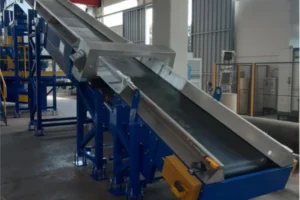
Example of a Monti Impianti belt conveyor used in waste management
Which conveyor belts are best suited for industrial waste management?
There are different types of conveyor belts for the waste industry : each configuration is designed for a specific type of material and function.
Here are the most common solutions in waste treatment:
Troughed belt conveyors: Perfect for light or dusty waste.
The sloped sides retain material during transport and reduce dispersion. They can be equipped with a vacuum system for working in dusty environments. They’re the perfect choice for those seeking order and cleanliness in the flow.
Belt conveyor Spondaflex
is ideal for loose, unstable, or discontinuous materials.
Thanks to its high sides and cross slats, it keeps everything under control even with irregular loads. It is often used for bulky waste, such as packaging, mixed plastics, or demolition waste.
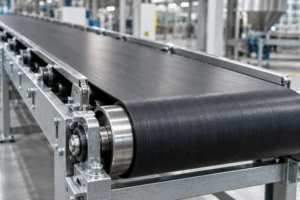
Flat belt conveyor.
Linear, simple, and versatile.
It’s the most commonly used solution for manual sorting, sorting, or quality control. The smooth surface is easy to clean and compatible with sensors, optical sorters, or dynamic scales. Ideal for compact spaces.
Metal Plate Conveyor: need something truly robust?
This belt is designed for heavy, abrasive, or hot loads. The steel plates resist wear and impact. It’s perfect for tough industrial waste, scrap metal, machining waste, or dewatered sludge.
Automating waste management with Monti Impianti
Effectively addressing industrial waste management means investing in intelligent, flexible, and durable systems. Automation, when properly designed, can transform operational challenges into measurable competitive advantages: greater efficiency, lower costs, and greater safety.
Monti Impianti supports companies that want to make this step with informed and technical expertise. With over thirty years of experience in designing and manufacturing custom conveyor belts , the company offers tailored solutions for every phase of waste treatment: from infeed to transfer, to final storage.
From the choice of materials to the mechanical configuration , up to the integration with sensors and remote control systems , each Monti system is designed to adapt to your process and accompany you towards a more sustainable, automated and reliable management model.
Want to learn more about the solutions available for your industry? Contact us for a technical consultation!