In the ultra-competitive context of the metalworking industry, the efficient management of waste (chips, scrap) and semi-finished products is no longer a simple logistical burden, but a strategic factor that determines the profit margin.
It’s not just about “disposal.” Every unfinished product and every accumulation of scrap represents a potential hidden loss: of time, operating space, safety, and, ultimately, costs. To maintain the promised efficiency, automated lines must therefore integrate fluid, continuous, and controlled handling systems.
This is where industrial conveyor belts abandon their role as simple components to become the vital backbone that connects machines, processing stations and collection or recycling areas, ensuring the constant flow of production 4.0.
In this scenario, the need for a technical partner with specific experience in the metalworking industry emerges. Monti Impianti is the Italian point of reference for transforming this need into integrated and customized solutions.
In the following paragraphs, we will analyze in detail the pillars of optimized management and, above all, the technical criteria that drive excellence.
Why it is essential to optimize the management of waste and semi-finished products
Optimizing the management of waste and semi-finished products means making the production process more efficient, safe, and traceable. Let’s see how.
Reduce downtime and increase productivity
In metalworking lines, every machine downtime or slowdown, often caused by accumulations of scrap or unhandled semi-finished products, directly impacts productivity. Automating collection and handling allows for reduced downtime, eliminating manual intervention, and maintaining a constant production flow.
Greater safety and order in the working environment
Manual intervention in processing areas with chips, sharp swarf, or heavy semi-finished products poses high risks. Automating the process with dedicated conveyors reduces operator exposure and improves overall ergonomics . Furthermore, a tidy, obstacle-free area improves internal logistics and facilitates inspections and maintenance.
Traceability, efficiency and sustainability
Beyond productivity and safety, optimal management allows you to track the flow of materials —semi-finished products passing through multiple stations, waste going to recycling or disposal. This allows you to identify inefficiencies (e.g., excessive waste compared to the target), improve separation, reduce resource consumption, and—from an Industry 4.0 perspective— integrate data into the management system.
The role of conveyor belts in waste and semi-finished product management
Conveyors elevate the production line from a sequence of machines to an integrated and controlled system, ensuring continuity, safety, and precision in material handling. This makes them a key factor in achieving greater Overall Equipment Effectiveness (OEE) .
Continuous, automated and customized movement
Conveyor systems are not just a means of movement, but the connectivity infrastructure for automated lines, essential for the smooth and synchronized passage of semi-finished products between high-value-added stations (such as CNC cutting, robotic welding, and finishing). At the same time, they ensure the systematic and immediate collection of waste (chips, swarf, and dust).
In the specific context of metal scrap and semi-finished products, the technical requirements are extremely stringent and require dedicated process engineering:
| Technical requirement (challenge) | Impact on the tape | Possible solutions |
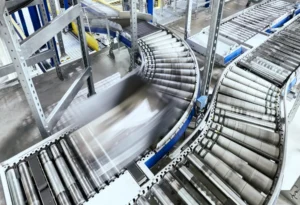
| Abrasion and heavy loads | Accelerated wear of the carpet, potential deformation of the structure. | Reinforced roller conveyors ( roller tracks ) or chain conveyors with wear-resistant steel plates; roller tracks with sealed bearings and lifetime lubrication. |
| Fluid contamination | Risk of corrosion, material slippage, need for coolant recovery. | Trough conveyors or screw conveyors with perforated belts and integrated collection tanks, combined with magnetic filtration systems for fluid reuse. |
| Metal shavings (Shape) | Long (bushy) shavings may tangle; fine shavings may fall out. | Hinged plates and wire mesh conveyors, bucket conveyors or belt elevators with specific sides and pallets to handle fine shavings and metal sludge |
| Thermal resistance | Risk of damage to the tape near hot processes (e.g. forging, laser cutting). | Roller conveyors and chain conveyors with high heat-resistant belt materials and structural components (150–200°C). |
The correct characterization of the flow (hourly flow rate, volumetric density, physical state) is therefore the foundation for the choice of the belt, as it determines not only the efficiency but also its operating life (useful life).


How to choose the most suitable conveyor belt for handling waste and semi-finished products
Choosing the most suitable conveyor belt for handling waste and semi-finished products depends on an analysis of the materials, the environment, and the production flows: parameters that determine the system’s efficiency and longevity.
Detailed analysis of production flow and material
Before defining the system, it is essential to analyze in detail:
- Type of semi-finished product or waste: weight, size, shape (blade, chip, sheet metal, particle)
- Condition: whether wet with coolant, with oil, or dry
- Generation frequency and quantity: (e.g. 150 kg/h of fine chips; 20 blocks/h of 200 kg)
- Transport route: length, ascent/descent, curves, number of stations involved
- Work environment: temperature, presence of dust or shavings, possible explosiveness
Energy efficiency, maintenance and total costs
A well-designed system must not only function well, but also be efficient in terms of energy consumption and maintenance costs. Some best practices:
- Use high-efficiency motors and variable frequency drive (VFD) to match speed to actual load
- Provide easy access for inspection and maintenance: a common mistake is the difficulty in accessing critical components (heads, rollers, motors).
- Provide abrasion-resistant components (e.g. a US steel, wear-resistant coatings) that are easily replaceable: they increase the life of the belt.
- Consider the total cost of ownership (TCO): not just initial cost but also consumption, downtime, spare parts, and maintenance hours.
Compatibility with automation and business systems
In an automated line environment, it’s essential that the conveyor belt be integrated with PLC/SCADA, accumulation sensors, vision systems, pick & place robots, and automatic waste sorters . The ability to communicate with and be part of a “smart” system is a plus. When choosing, it’s helpful to ask yourself:
- Does the belt have provisions for accumulation sensors, automatic stop, fault reporting?
- Can the speed be modulated according to the load?
- Is it ready for integration with a company’s MES/SCADA system?

Monti Impianti solutions for the automated management of waste and semi-finished products
Thanks to many years of experience in the metalworking sector, Monti Impianti designs integrated and customized solutions, capable of covering the entire process: from the point of generation of the waste or semi-finished product to its final destination (recycling, disposal, reuse).
Here are the distinctive technical advantages of Monti Impianti solutions:
- Custom design: production layout study, flow simulation, belt sizing (speed, width, belt) and verification with simulation software.
- High-performance materials: steel or wear-resistant alloy belts for harsh environments, rollers with sealed bearings, IP66 motors in environments contaminated by chips or oil.
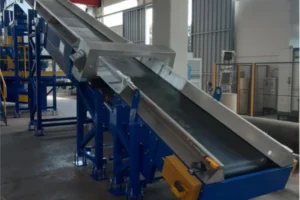
- Automatic collection and separation systems: for example, inclined belts that separate lighter waste from heavy scrap via vibration, filter or magnetic separator.
- Full compatibility with automated systems: ready for integration with robots, PLCs and control systems, ready for Industry 4.0 (load sensors, preventive diagnostics).
- Service and scheduled maintenance: dedicated assistance, spare parts, predictive interventions to reduce machine downtime.
If your metalworking company faces problems with waste accumulation, manual movements, integration difficulties, or complex layouts, contact Monti Impianti for a free consultation: we’ll analyze your production flow, define the ideal conveyor belt, and show you how to improve efficiency, safety, and sustainability.
Frequently asked questions about automated waste and semi-finished product management
- What is the ideal speed for a metal scrap conveyor belt?
The speed of a conveyor belt depends heavily on the type of material, load, gradient, and layout. In metalworking plants, moderate speeds (0.3-0.6 m/s) are often chosen to ensure load stability, liquid drainage, and belt integrity. Factors such as particle size and the presence of refrigerant or oil influence this parameter.
- Which carpet material should I choose for semi-finished products and metal scrap?
If you’re transporting fine workpieces, chips, or mixed swarf with coolant, a steel or durable, wear-resistant polyurethane belt is preferable. For larger workpieces, a PVC or polyurethane belt may suffice for “clean” handling.
- How to ensure that the tape does not become a bottleneck in the line?
It’s essential to correctly size the width, speed, and length based on the hourly flow rate, provide buffers or accumulation zones, integrate stop/accumulation sensors, and adopt VFD motors to adapt to load variations. Furthermore, preventative maintenance eliminates unexpected downtime.
the hourly flow rate, provide buffers or accumulation zones, integrate stop/accumulation sensors, and adopt VFD motors to adapt to load variations. Furthermore, preventative maintenance eliminates unexpected downtime.