To choose the right conveyor belt within an automated production flow, it is necessary to analyze three fundamental variables:
- the nature of the load (weight, shape, temperature)
- the layout of the course (straight, curved, inclined)
- the operating environment (presence of oils, dust or need for sanitization)
With over 40 years of experience at Monti Impianti , we can assure you that the optimal solution is not the cheapest component, but the one that guarantees the lowest Total Cost of Ownership (TCO), reducing machine downtime and energy consumption thanks to precise electromechanical sizing.
The main types of industrial conveyor belts
The choice of a handling system primarily concerns the machine’s architecture, as a function of the production flow. One of the first criteria to consider is the layout of the conveyor belt’s path.
1. Linear and curved transport systems
For horizontal sections and direct connections, the layout aims for efficiency and stability of flow. If the route is purely straight, the standard configuration involves the use of
- Belt conveyors
- Roller conveyors
- Chain conveyors


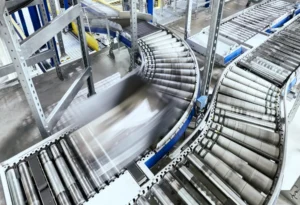
However, when the space requires tight curves or lateral transfers, the architecture turns towards solutions such as:
- Modular chain conveyors
- Rotating tables
- Belt conveyors arranged orthogonally


2. Solutions for overcoming differences in level (elevation)
When the production flow develops on multiple floors, the machine architecture must guarantee load containment against the force of gravity.
For steep slopes, the layout requires the integration of systems that create containment pockets, such as:


If the floor space is extremely limited and the transport must be purely vertical (90°), the engineering solution falls to:


3. Transport of bulk and heavy materials
In routes that pass through critical process zones or handle difficult materials, the architecture becomes specialized to ensure product protection and component durability. In this context, Monti Impianti’s design involves the use of:
- Conveyor belts in troughs
- Hinged plate conveyors
- Wire mesh conveyors


4. Auxiliary systems and end-of-line automation
The layout is completed where transport becomes active logistics, interfacing with the final packaging stages, where the following are used:
- Rotating tables for accumulation
- Destackers and stackers

Choose the conveyor belt based on the weight, shape and temperature of the load
When a customer asks us for support in integrating an industrial handling system, one of the first questions we address during the design phase is: “What do we need to move? “
The nature of the load is the parameter that defines the breaking strength of the belt, the motor power and the material of the contact surface.
Here are the key factors we analyze to ensure a reliable system:
1) Load weight
Weight determines breaking strength and electromechanical sizing : excessive, unsupported loads cause deformation of the sliding surface or premature failure of the belts. At Monti Impianti, we calculate the required tension based on the conveyor length and operating speed.
- In case there is a need to move rigid loads (pallets) we recommend roller conveyors and chain conveyors
- In the presence of metal pieces or heavy industrial loads, we opt for hinged plate conveyors and rubber conveyor belts
2) Size and volume of the load
The belt dimensions must be strictly adapted to the volume of the products to prevent them from becoming stuck. It is essential to validate the belt’s effective width based on load fluctuations during flow.
For example, for loose or shapeless materials (grains, powders, waste), our technicians design troughed belt conveyors or Spondaflex systems . These solutions create a “U”-shaped containment that prevents lateral dispersion, ensuring maximum cleanliness and operational safety.
3) Load type and temperature
The physical-chemical characteristics and temperature of the load (residual heat) are the main factors responsible for thermal shock and premature degradation of the mat. At Monti Impianti, we select materials based on the product’s reactivity: from polyurethane (PU) for food hygiene to heat-resistant rubber or metal mesh for parts coming out of ovens at temperatures above 200°C.
Given the complexity of the available compounds, we have drawn up a specific guideto help you identify the most durable covering for your application: Conveyor Belt Materials
The choice of the handling system based on the operating environment and sectors
The environmental conditions of the production site are crucial to the longevity of the system. The conveyor belt must be selected using materials and structures capable of withstanding external agents.
- Conveyor belts for environments requiring rigorous hygiene.
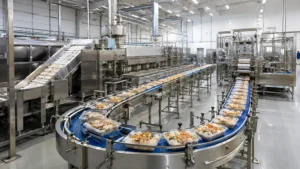
Where hygiene requirements are a priority, such as in the case of conveyor systems for the food , pharmaceutical, or cosmetics industries, the solution of choice is stainless steel combined with polyurethane belts or modular chains . These materials ensure resistance to frequent washing and inhibit bacterial growth. - Conveyors for handling oils, greases, and abrasive substances: For conveyor belt applications in the metalworking industry or waste recycling, the use of oil-resistant rubber covers or hinged plate conveyors is essential . These systems are designed to withstand cuts, sharp edges, and the corrosive action of hydrocarbons.
- Solutions for dusty environments and large-volume handling
In sectors such as the paper industry or the transport of bulk materials, it is preferable to focus on sealed configurations or troughed belts . These architectures protect the moving parts and limit the dispersion of residues into the work environment. - Conveyor belts for extreme ambient temperatures
In the presence of cold rooms or high radiant heat, the design must include components with specific lubricants and steels that maintain mechanical fluidity , avoiding the crystallization of plastic parts or the seizure of transmissions.
Technical parameters for final sizing for the choice of a conveyor belt
Before proceeding with the integration of a new conveyor system, it is necessary to validate some mechanical parameters that are fundamental for the constant efficiency of the line:
- Capacity and Flow Rate (t/h): The electromechanical sizing must be calculated on the basis of the maximum expected peak load, in order to ensure that the motor and the structure operate safely even during the phases of maximum production stress.
- Drum diameter and belt stiffness: It is essential to ensure that the curvature radius of the chosen material is compatible with the diameters of the existing rollers; using a belt that is too stiff on small-diameter drums would lead to premature cracking and structural failure of the belt.
Mistakes to avoid when choosing the handling system
A poor investment in the configuration phase can jeopardize the entire productivity of your site. Drawing on our 40 years of experience, we’ve identified the most common technical oversights that can be avoided with careful planning:
- Underestimating the coefficient of friction: not considering how humidity or product residues change the adhesion between the belt and the drum leads to slippage that overheats the engine.
- Neglecting transfer points: A layout that lacks chutes or smooth transitions between belts causes shock, damaging the product and accelerating wear on the belt edges.
- Prioritize immediate TCO savings: Purchasing a conveyor based solely on initial price ignores future costs related to frequent maintenance, unexpected line downtime, and high electricity consumption due to inefficient mechanics.
- Ignoring ease of maintenance: Installing systems that are difficult to disassemble or clean dramatically increases downtime during sanitization cycles or replacing worn components.
Plan your line efficiency today!
Choosing the right conveyor is a complex balance between materials engineering, loading physics, and space optimization. A well-designed conveyor system is not just a link between two machines, but an efficiency multiplier for the entire industrial flow.
Do you need technical support to define the layout or type of tape best suited to your application?
Monti Impianti ‘s experts are available for personalized technical advice. Thanks to over 40 years of experience in multiple industrial sectors, we analyze every variable to ensure a reliable, long-lasting system tailored to your specific production needs.