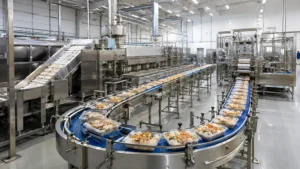
It’s often assumed that an industrial conveyor line, if properly designed, should maintain its performance until the end of its life cycle. However, operational reality reveals a different phenomenon: a progressive and imperceptible slowdown in production capacity.
This drop in efficiency isn’t necessarily due to a flaw in the original design, but rather to a series of systemic and dynamic variables. Understanding why this happens is the first step to restoring the desired output levels.
The concept of “performance drift” in automation
Even the most advanced systems, such as the Chain conveyors are subject to performance drift . This is not a sudden failure, but an accumulation of inefficiencies that cause the line to run, for example, at 92% of its nominal speed instead of 100%.
Let’s see the causes that lead to this phenomenon
1. Parasitic friction and mechanical resistance
Over time, environmental dust, processing residues, and lubricant degradation increase the coefficient of friction between moving parts. Even a slight increase in resistance on each roller or pinion forces the motor to absorb more energy, often leading control systems to reduce speed to avoid thermal overload.
2. Elongation of the tensile components
Chains and belts are subject to natural mechanical stress . The elongation ( creep ) of the materials changes the transmission pitch. In synchronized systems, this millimetric phase shift can generate small delays in sensor readings, forcing the PLC ( Programmable Logic Controller) to introduce pauses or slow down the cadence to maintain synchrony between the stations.
3. Wear of the sliding profiles
In handling solutions such as on hinged plate and wire mesh conveyors , wear on the polyethylene or steel slide guides impairs the fluidity of movement. When the conveyor surface is no longer perfectly flat, vibrations are created that can destabilize the product, forcing operators to slow down to avoid falls or damage.
External factors contributing to the slowdown: the changing operating environment
Sometimes the slowdown is not due to the machine, but to what it is carrying.
- Packaging Changes: Even a small change in packaging material (e.g. thinner plastic or rougher cardboard) changes the coefficient of friction.
- Environmental Conditions: Humidity and temperature influence the viscosity of lubricants and the tension of synthetic materials.
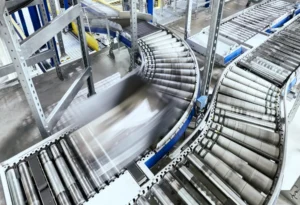
In storage and logistics contexts, the use of Roller conveyors or roller tracks require constant calibration: a slightly less fluid bearing on a hundred rollers can generate a “plug effect” that slows down the entire flow.

Design solutions to maintain constant speed
To counteract physiological slowdown, Monti Impianti adopts specific design measures:
Power consumption monitoring
By integrating latest-generation inverters , it is possible to constantly monitor the driving torque. An abnormal increase in absorption is the first sign of increasing friction, allowing intervention before the speed must be reduced.
Automatic tensioning systems
The use of automatic tensioners (spring or pneumatic) ensures that the belt or chain always maintains the correct geometry, compensating for natural elongation without the need for frequent machine stops.
Low friction materials
The use of guides and profiles made of self-lubricating technopolymer materials drastically reduces heat accumulation and long-term mechanical resistance.
FAQ: Frequently asked questions about slow lines
Why does my line often stop for short periods (micro-stops)?
Micro-stops are often caused by sensors detecting product misalignment. If the chain or belt has stretched slightly, the product doesn’t reach the sensor within the expected “window time,” causing a safety stop.
Can prevent slowdowns with preventative maintenance?
Yes, but it must be predictive maintenance. Lubrication alone isn’t enough; you need to measure the deviation between the set speed and the actual speed (tachometric) to identify where efficiency is being lost.
Does swapping engines for more powerful versions solve the problem?
Rarely. A more powerful engine only hides the symptom (friction), but doesn’t address the cause. In fact, it can accelerate the failure of mechanical components subjected to stresses for which they were not designed.
The value of specialized technical consultancy
A slow line is an invisible cost that eats away at your profit margin every day. At Monti Impianti , we don’t just build conveyors; we analyze the life cycle of the entire system to ensure that day-one performance remains the same after years of intensive operation.
Is your figure not performing as well as it used to?
Our technicians can perform a complete audit of your transportation system, identifying mechanical bottlenecks and proposing targeted revamping or optimization interventions.