In the food industry, continuity between machines also depends on the quality of internal handling. A product can exit the process, pass through inspections, be diverted, accumulated, and finally fed into the packaging: at each stage, the conveyor system must respect the rhythm of the line, the available space, and the product’s characteristics.
Transporters for the food sector They connect the various production phases and help streamline the flow of unpackaged, packaged, or pet food products. The choice, however, depends not only on the type of food: format, speed, layout, height differences, washing frequency, storage requirements, and integration with existing machinery also play a role.
Why do conveyor belts impact the efficiency of the entire food supply chain?
Conveyor belts for the food industry aren’t just connections between two machines. They define the way the product moves along the line, reducing disruptions, waiting times, and unnecessary manual handling.
When a line comprises processing, quality control, packaging, and end-of-line operations, each section must be designed to take into account the actual throughput of the upstream and downstream machines. A conveyor that is undersized, too fast, or unsuitable for the product can cause irregular buildup, spills, slowdowns, or difficulty accessing during cleaning.
Operational continuity also depends on the system’s ability to absorb speed differences between the various stations. A buffer section, a controlled diversion, or a rotary table can prevent a localized slowdown from halting the entire production process.
For this reason, when designing a food line, transport must be considered an integral part of the process. Monti Impianti creates industrial handling systems tailor-made, evaluating the product, flow, available spaces and machines to be connected.
What solutions are needed at different stages, from processing to packaging?
The right solution varies along the product’s journey. Linear conveying, diversion, quality control, elevation, and accumulation require different configurations, which must be integrated without interfering with the processing or packaging phases.
From the exit of the processing to the transfer between the machines
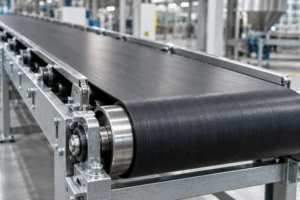
After a processing stage, the product often needs to be transferred to a subsequent machine, an inspection stage, or a packaging area. For straight, horizontal, or slightly inclined sections, belt conveyors They represent a solution to be evaluated for the handling of naked, loose or packaged products.
The conveyor belt configuration must be defined based on the product’s shape, weight, stability, temperature, and surface area. Elements such as side guides, containment edges, centering systems, headroom, and transfer speed may also play a role.
In the food industry, a conveyor belt can directly connect two machines or help distribute the product across multiple lanes. In some configurations, retractable systems, scrapers, and scrap collection can be designed to manage process requirements and waste disposal.
Orientation, deviation and format changes
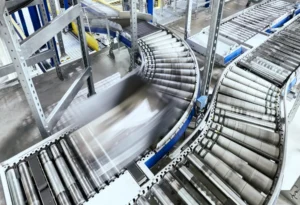
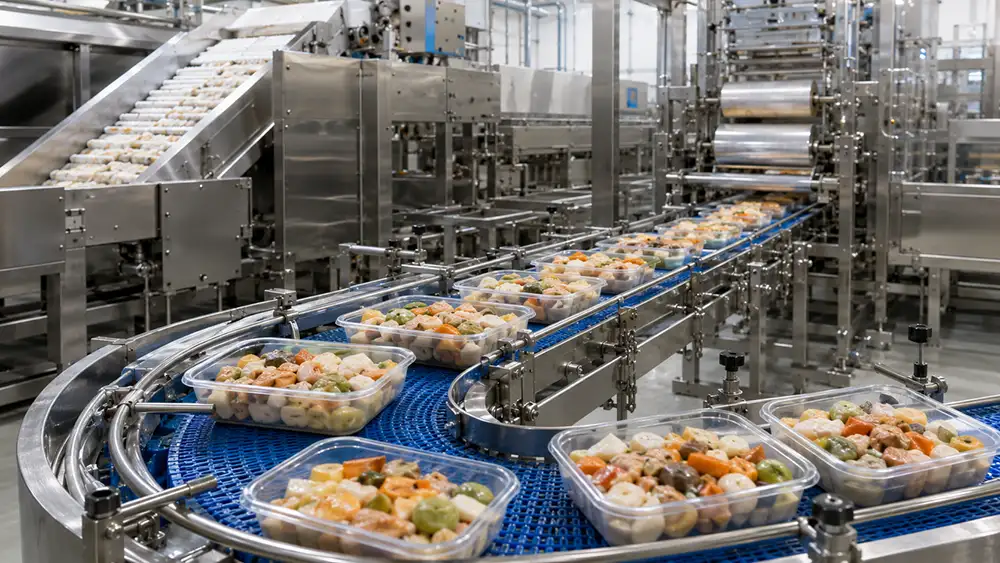
When the product must negotiate curves, lateral deviations, changes in direction or accumulation phases, modular chain conveyors (Intralox) may be more suitable. These systems can be used for straight and curved paths, horizontal or with ascents and descents.
Modular conveyors can be configured with adjustable guides, specific modules, sidewalls, and dedicated solutions for managing format changes. When handling products of different sizes, adjusting the guides and containment systems helps maintain a more orderly flow, without forcing the product during transfer.
At points where it is necessary to divert a product, for example after a process check, the design can include motorized ploughshares, pneumatic diverters or other systems consistent with the overall configuration of the line.
Quality control, rejection and anomaly management
The quality control phase requires that the product arrives in the correct position and at an adequate distance from the elements preceding or following it. The conveyor does not replace inspection or detection systems, but can be designed to facilitate their integration and streamline the management of compliant and non-compliant products.
A retractable conveyor, pneumatic diverter, or orthogonal section for reject evacuation can be considered when the line must separate product for further inspection or removal from the main flow. The choice depends on the type of item, its fragility, the line speed, and the existing control logic.
Packaging feeding and end-of-line
Before packaging, a controlled accumulation phase can compensate for brief differences in pace between processing and packaging. This doesn’t mean creating a random product deposit, but rather setting up an area capable of maintaining an orderly flow, avoiding immediate stops upstream when a downstream machine temporarily slows down.
At the end of the line, the rotary tables They can be considered for direction changes, end-of-line accumulation, or replacement of motorized curves when space is limited. Product diameter, available space, speed, and entry and exit modes must be considered in the design.
| Line requirement | Solution to be explored further | Variables to evaluate |
|---|---|---|
| Linear transfer between two cars | Belt conveyor | Product type, speed, cleanliness, slope, head passages |
| Curves, deviations or accumulation | Modular chain | Curve radius, guides, format change, product, accumulation |
| Overcoming differences in height | Belt elevator | Overall dimensions, inclination, containment, product features |
| Transit into or out of ovens | Wire mesh | Temperature, product size, mesh, cleanability |
| Change of direction or accumulation at the end of the line | Rotating table | Available space, product diameter, speed, rotation logic |
How to choose a food conveyor that promotes hygiene, cleanability, and operational continuity?
The design must consider accessibility, cleanability, and the materials of the parts involved in the process from the outset. There is no one-size-fits-all configuration for every food processing plant: requirements vary based on the product, cleaning procedures, and level of food contact.
The general framework is defined by Regulation (EC) No 852/2004, on the hygiene of foodstuffs, and by Regulation (EC) No. 1935/2004, Referring to materials and objects intended to come into contact with food. During the design phase, it is therefore necessary to verify on a case-by-case basis which components come into direct or indirect contact with the product and which documentation requirements are necessary.
For a conveyor designed to handle uncovered food, ease of surface inspection, access to internal areas, the ability to remove or open certain elements, and the management of residues, water, or washing liquids are key.
they can be designed with features such as slots, removable covers, collection trays and configurations that simplify the operations envisaged by the plant.
For packaged products, priorities may vary: package stability, adjustable guides, control of distance between products, and compatibility with bottles, trays, cartons, cartons, cans, or bags. For pet food, however, it’s necessary to evaluate the format, weight, type of packaging, and characteristics of the upstream and downstream lines.
How to manage curves, differences in level, format changes, accumulation and quality control?
Curves, different dimensions, and format variations require solutions that keep the product stable and the flow legible. The technical solution depends on the combination of layout, product, and process logic, not just the conveyor length.
Overcoming a difference in height without interrupting the flow
When the product needs to reach a higher level, be loaded into a hopper or transferred to a subsequent machine located higher up, belt elevators can be considered. The presence of slats and containment systems can be defined based on the shape of the product, the inclination and the need to avoid regression during transport.
Elevation should not be designed in isolation: it is important to check how the product enters the elevator, how it is unloaded and what speed the subsequent section must maintain. A poorly thought-out transition can compromise the smoothness of the line even when the single elevator is correctly sized.
Handling products at high temperatures or near ovens
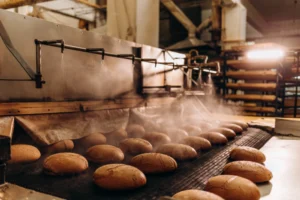
For products entering or exiting ovens, or handled at temperatures above ambient, wire mesh conveyors can be considered. In the food industry, they are used, among other things, to transport products such as bread, biscuits and pizzas.
In these situations, the wire mesh must be selected based on temperature, product size, mesh type, speed, inclination, and expected cleaning methods. The oven entry and exit points must also be coordinated with the existing machinery to avoid unstable transfers or misalignments.
Accumulation and change of direction in small spaces
When a motorized curve would take up too much space or the product must be accumulated at the end of a line, a rotary table can be a useful configuration worth exploring. Its function is not only to rotate the product, but also to manage the transition from one direction to another with a consistent logic regarding speed, presence of sensors, and unloading priority.
Proper use of accumulation requires defining how much product needs to be temporarily handled, for how long, and in what order. Accumulation is useful when it protects line continuity; it becomes inefficient when it masks a bottleneck that should be addressed upstream or downstream.
What information is needed to design a custom handling line?
Designing an effective system requires concrete data on the product and the process. A generic request for “food-grade conveyor” is a starting point, but it’s not enough to properly define the structure, belt, guides, motors, and accessories.
Before designing, it is useful to gather some information.
- Product type: naked, packaged, frozen food, baked product or pet food.
- Format and dimensions: length, width, height, weight and stability.
- Throughput and speed: pieces per minute, kg/hour, continuous or intermittent flow.
- Available layout: lengths, curves, dimensions, maintenance spaces and access.
- Machines to be connected: entry and exit height, production rate, sensors or existing systems.
- Process requirements: accumulation, diversion, selection, waste evacuation, format changeover.
- Operating conditions: temperature, humidity, residues, washing requirements and cleaning frequency.
To learn more about these criteria, it is also useful to consult the guide on how to choose a conveyor belt. A complete technical evaluation starts from the actual flow of the product, not from the single component.
A more fluid line, from process to packaging
From processing to packaging, an efficient food line is born from the integration of product, machinery, and handling. Conveyors, modular chains, elevators, metal meshes, and rotary tables meet different needs and are effective when designed with the actual flow of the plant in mind.
Monti Impianti supports companies in designing customized handling systems, analyzing layout, product characteristics, process requirements, and operating conditions before defining the most appropriate solution.
FAQ – Frequently Asked Questions
Which conveyors are suitable for unpackaged foods?
For non-packaged foods, belt, modular chain or wire mesh conveyors can be evaluated, depending on the product and the production phase. They must be Carefully consider contact methods, cleanability, waste management, washing frequency, and required documentation for the materials used.
When to choose a belt conveyor and when to choose a modular chain?
A belt conveyor is often suitable for linear sections and connections between machines, while a modular chain may be more suitable when curves, inclines, declines, adjustable guides, or accumulation are required. The choice, however, depends on the product, speed, format, and available layout.
How do you manage curves and changes of direction in a food line?
Curves can be handled with modular chains, rotary tables, or configurations with orthogonally arranged conveyors. It’s important to check the curve radius, product stability, lateral guides, access clearances, and synchronization with upstream and downstream machinery.
What is the purpose of an accumulation phase before packaging?
Pre-packaging accumulation helps compensate for brief differences in pace between processing and packaging. When properly designed, it allows for a more continuous flow without creating pressure or product disruption.
When is a wire mesh conveyor useful?
A wire mesh conveyor can be useful for transporting products near ovens or at temperatures above ambient. The configuration must be evaluated based on temperature, product size, mesh type, speed, and operating conditions.