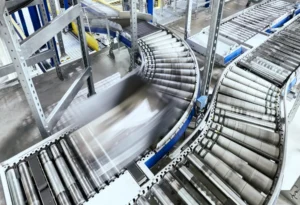
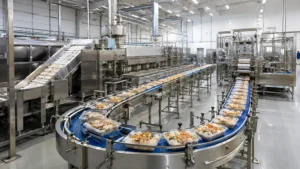
Understanding the differences between modular and custom systems is essential for evaluating initial costs, maintenance costs, and long-term reliability of the line. The choice not only concerns the conveyor configuration, but also affects how the system integrates with production, manages materials, and responds to any future changes.
A modular system can be an effective solution for standardized and easily reconfigurable applications. A custom-designed system, however, can offer greater advantages when handling requires precision, continuity, integration with other machinery, or specific technical features.
Modular and custom systems: what really makes a difference?
The main difference is the level of system adaptation to the line’s operating conditions. A modular system is built using standard, combinable elements, such as conveyor sections, curves, accumulation modules, guides, and configurable components.
A custom system, on the other hand, is the result of a specific analysis of the application. The design considers the material handled, weight, dimensions, capacity, speed, layout, operating environment, connected machinery, and automation requirements.
Modularity can simplify some configurations and future modifications. Custom design, on the other hand, reduces technical compromises, creating a system more consistent with the actual production process.
When a modular system can be an effective choice
A modular system is suitable when the line requires operational flexibility , simple configurations, and easily adaptable components. This solution can be useful when the product being handled is standardized and does not present any particular transport issues.
Configurable modules can make it easier to expand the line, add new sections, or modify certain routes. This is especially useful for companies that anticipate gradual production growth or work with frequently changing layouts.
In these cases, modularity allows for system modifications without completely redesigning the plant. However, this solution is only effective when the available modules adequately meet the handling needs.
Limitations of modular systems in the most complex applications
A modular system may become less effective when faced with specific handling conditions. If the product is heavy, unstable, abrasive, fragile, very hot, or subject to specific processing, a standard configuration may not be sufficient.
The risk is having to adapt the process to the plant’s characteristics, rather than designing the plant around the process. This can lead to compromises in speed, throughput, material stability, maintenance, and integration with existing machinery.
The critical issue isn’t modularity itself, but its use in contexts requiring specific geometries, precise synchronization, specific materials, or high production rates. In these situations, a standardized solution can create inefficiencies that only become apparent over time.
Customized systems for complex production lines
A custom system is designed to adapt to the actual needs of industrial handling. This approach allows each element of the system to be tailored to the production process : structure, drive system, motorization, speed, inclination, loading and unloading points, guides, and safety devices.
Customization is especially important when the conveyor must integrate with robots, packaging machines, dosing systems, processing machines, control systems, or manual stations. In these contexts, even small layout details, cycle times, or transfer points can impact the productivity of the entire line.
A custom-designed system allows you to address these aspects right from the initial phase, avoiding subsequent adjustments that could increase costs, downtime, or management complexity.
Initial costs: price is not the only parameter to evaluate
A modular system may require a lower initial investment, but the purchase price doesn’t always match the actual cost over time. A proper assessment must include future modifications, maintenance, consumption, downtime, and the impact on productivity.
A custom system may require more in-depth initial planning and a greater investment. However, if designed correctly, it can reduce inefficiencies, frequent adjustments, and unscheduled interventions due to system limitations.
The comparison must therefore consider the total cost of ownership . A seemingly cheaper system may become less cost-effective if it requires constant modifications to adapt to the line or if it causes slowdowns in handling.
Ordinary and extraordinary maintenance: where convenience changes
Maintenance depends on component quality, operating conditions, and consistency between system and application. A standardized system can simplify the replacement of certain parts, thanks to the availability of modular elements and compatible spare parts.
However, when a system isn’t perfectly suited to the product or production rate, stress, wear, and the need for adjustments can increase. In these cases, the simplicity of the components doesn’t eliminate the underlying problem.
A custom-designed system can reduce issues related to overloads, buildup, misalignment, and premature wear. Maintenance remains necessary, but can be more predictable and consistent with the normal life cycle of the components.
Future flexibility and line changes
The difference between a modular system and a custom system is especially evident when volumes, products, layouts, or production methods change. A modular system can offer greater simplicity for linear modifications, such as adding sections, curves, or accumulation points.
A custom system, on the other hand, can be designed from the outset with room for evolution. This means planning for spaces, integration points, motors, sensors, or configurations designed for future line expansions.
The right choice, therefore, isn’t to prioritize modularity or customization. It’s important to assess how likely the process is to change and how it will need to change. In some cases, the most effective solution may be a customized system that integrates modular elements where flexibility offers a concrete advantage.
Plant layout, integration and safety
The conveyor must integrate with the production layout without creating obstacles, critical passages, or delays between phases. The quality of the design impacts the continuity of the line , the space occupied, and ease of access for operators and maintenance personnel.
When changes in direction, accumulation, product orientation, or connections between multiple machines are required, the system must be designed in a coordinated manner. Each transfer point must ensure material stability, regular flow, and operational safety.
Proper design must also consider protections, access points, cleaning, inspection , and safety during maintenance operations. These aspects impact downtime and the day-to-day operation of the system.
How to choose between a modular system and a custom system
The choice must begin with an analysis of real-world working conditions and not just the availability of standard components. An effective industrial handling system must support production without causing bottlenecks, abnormal wear, or frequent corrective interventions.
The main elements to evaluate include:
- type, weight and dimensions of the material moved;
- required flow rate and production speed;
- presence of processes, accumulations or synchronizations;
- layout configuration and available space;
- integration with existing machinery;
- frequency of use and environmental conditions;
- need for future expansion or modification of the line;
- maintenance and business continuity objectives.
A comprehensive technical assessment helps determine whether your application benefits from a modular design or requires a fully customized solution.

Custom-made handling systems from Monti Impianti
Monti Impianti designs and manufactures industrial handling solutions based on the specific needs of each company. The goal is to create reliable, efficient systems that are consistent with the material, process, and production , avoiding standard solutions that are unsuitable for the application.
Belt conveyors, chain conveyors, roller conveyors , elevators, rotary tables, and special systems can be designed and integrated based on capacity, layout, automation, and product characteristics. This way, modularity and customization aren’t rigid alternatives, but design tools to be used based on the desired outcome.
FAQs on modular and custom-made systems
Does a modular system always cost less than a custom-made system?
Not necessarily. It may have a lower initial cost, but its cost-effectiveness must also be assessed considering future modifications, maintenance, downtime, and adaptation to the production line.
Can a custom system be modified in the future?
Yes. A customized project can be prepared for future expansions, new machines, layout changes, or variations in production capacity.
When can modularity become a limitation?
Modularity can be limiting when the material, layout, or process requires special geometries, high precision, specific flow rates, or complex integration with other machinery.
Which solution requires less maintenance?
It depends on the consistency between system and application. A system properly sized and designed for real-world operating conditions tends to require more predictable maintenance.
What data is needed to evaluate the most suitable solution?
Data is needed on the product handled, flow rate, speed, layout, connected machinery, work environment, cycle times, safety requirements, and the potential for future evolution.