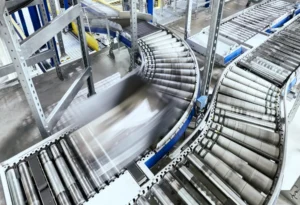
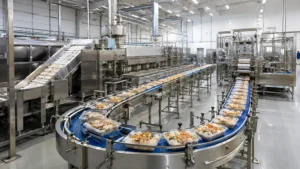
The choice between continuous and intermittent conveying depends on the type of process, cycle times, and the level of precision required along the production line. An industrial conveying system must not only move material from one point to another, but must also respect the machine’s speed, product stability, and the operational requirements of the entire process.
Understanding which mode to adopt allows you to avoid buildups, misalignments, slowdowns, and critical issues in line management. The difference between continuous and intermittent conveying becomes truly crucial when the product must stop for a process, be precisely positioned, or advance without interruption to maintain a constant flow rate.
Continuous and intermittent transport: what’s changing in industrial handling?
The main difference concerns the way the material advances along the line. In continuous conveying , the product moves steadily, without scheduled stops between stages. In intermittent conveying, however, the movement alternates between advances and controlled pauses, defined based on the planned processes.
This distinction isn’t simply about conveyor speed. It also changes the relationship between movement and process, the level of synchronization required with downstream machines, and the precision with which the product must reach individual operating stations.
When to choose continuous transport
Continuous conveying is recommended when maintaining a smooth, uninterrupted production flow is the priority . This solution is suitable for lines where material must be transferred quickly from one stage to the next, without the need to stop at specific locations.
It can be used to handle industrial components, packaging, containers, loose products, or materials destined for further processing. In these cases, the continuous movement helps maintain a constant line flow rate and reduce waiting times between machines.
Continuous conveying is only effective if it is correctly sized for weight, speed, throughput, and operating conditions. For many applications, belt conveyors , designed based on the material and production layout, can be the solution.
Intermittent transport for precise stops and operations
Intermittent conveying is the most suitable choice when the product must stop at specific points on the line. In this case, controlled positioning becomes an integral part of the production process.
The conveyor advances for a defined distance, stops, and restarts according to programmed times. This logic is useful when the material must undergo operations such as assembly, filling, dosing, labeling, quality control, machining, or unloading.
The quality of an intermittent system depends on the precision of stops and the regularity of restarts. Each product must reach the correct station at the correct time, avoiding alignment errors, wasted time, or unnecessary manual interventions.
When the choice between continuous and intermittent transport really changes
The choice really changes when handling must adapt to process times and not just line speed. If the product needs to be transferred without intermediate processing, continuous conveying can ensure greater fluidity and continuity.
However, if a machine must operate on the product in a specific position, or if each stage requires a defined amount of time, intermittent conveying often becomes the most suitable solution. The key is not to choose the seemingly fastest system, but to identify the one that allows the entire line to operate in a coordinated manner.
A continuous conveyor that isn’t synchronized with downstream machinery can create backlogs and slowdowns. Likewise, an intermittent system designed without proper consideration of cycle times can reduce overall plant productivity.
Line speed, throughput and cycle times
Conveyor speed must be evaluated in conjunction with production line cycle times . A continuous system can move material at a high rate, but this feature is only useful when subsequent processes can maintain the same pace.
In intermittent transport, however, it is necessary to precisely calculate both the advance and stop times. The duration of the pauses must be consistent with the operations performed along the line, so as to avoid a machine remaining idle or the product arriving prematurely.
The technical choice must therefore begin with an analysis of the entire process: material input, any backlogs, automatic processing, manual stations, checks, and finished product output.
Product stability during handling
Material characteristics directly impact the choice between continuous and intermittent conveying. Fragile, lightweight, unstable, or geometrically unique products require controlled handling , especially during start-up, shutdown, and restart.
Weight, size, center of gravity, surface area, and friction influence the behavior of the product along its path. In some cases, lateral guides, centering systems, sides, pallets, or specific transport surfaces may be required to maintain stability and orientation.
Conveyor technology should be selected based on the application. Chain conveyors may be considered for robust, heavy products or those subject to demanding operating conditions , while roller conveyors may also be suitable for packages, containers or materials with a rigid base .
Integration with machinery and production layout
The conveyor must be designed as an integral part of the line, not as a standalone component. Proper integration with the machinery is essential for both continuous and intermittent systems.
Dosers, packaging machines, robots, control systems, and loading and unloading stations must work seamlessly with the handling system. When the product needs to change direction, be oriented, accumulated, or transferred between multiple stations, specific solutions may be required.
In these cases, the integration of industrial rotary tables can facilitate the transition between different phases of the line, maintaining continuity, precision, and order in the production flow.
The main parameters to consider include:
- required flow rate and production speed;
- processing cycle times;
- type, weight and dimensions of the product;
- necessary precision in stops;
- presence of accumulations or synchronizations;
- available space and layout of the facility;
- integration with existing machinery.

Design the handling system according to the process
There’s no single best solution between continuous and intermittent conveying: the right choice depends on the actual conditions of use. A custom industrial conveyor must be designed with the product, process, and company’s production goals in mind.
In some lines, continuous transport is ideal for maintaining a constant flow between rapid, consecutive operations. In others, intermittent transport is necessary to ensure positioning, control, and synchronization. Often, both systems coexist on the same line, with continuous sections dedicated to transfer and intermittent stations dedicated to more precise operations.
A technical assessment allows you to correctly define speed, capacity, motorization, drive system, geometry, and accessories, avoiding standard solutions that are unsuitable for the actual needs of the system.
Custom-made industrial conveyors from Monti Impianti
Monti Impianti designs industrial handling systems based on the specific needs of the application. Each project is evaluated based on the material being handled , required throughput, cycle times, operating conditions, available space, and integration with the existing line.
Belt, chain, roller, and screw conveyors, elevators, and rotary tables can be configured to support both continuous and intermittent high-precision handling. The goal is not to offer a standard system, but to create a reliable, functional solution consistent with the company’s production process.
FAQ on continuous and intermittent transport
How do you know if a line requires continuous or intermittent transport?
The choice depends primarily on the type of processing required. If the product must advance without stopping, continuous conveyor is generally more suitable. If, however, it must be processed, controlled, or positioned with precision, an intermittent system may be necessary.
Is it possible to use continuous and intermittent transport on the same line?
Yes. Many plants use continuous-motion sections for material transfer and intermittent stations for operations requiring controlled stops .
Is intermittent transport increasingly less productive?
No. A properly designed intermittent system can be very efficient, especially when coordinated with machines that operate in cycles. Productivity depends on the balance between feeds, stops, and machining times.
Which solution is best suited for fragile products?
It depends on the product characteristics and the type of process. Intermittent conveying can offer greater control during stoppages, but a continuous system can also be designed with adequate speeds, guides, and supports to ensure stability.
What information is needed to design an industrial conveyor?
Data is required on the product handled, weight, dimensions, required flow rate, speed, cycle times, related processes, line layout, operating environment, and required level of automation.